ELEGOO Centauri Carbon 3D Printer, Enclosed CoreXY, 500mm/s, 320C Nozzle Review (2026)
Updated September 20, 2026 · Research-based review
Our verdict
The Centauri Carbon brings enclosed CoreXY printing and a 320C nozzle to a budget-friendly price, fitting makers who want ABS and ASA capability without paying Bambu-level prices. It lacks an actively heated chamber, so larger nylon parts can still warp compared with fully heated enclosures.
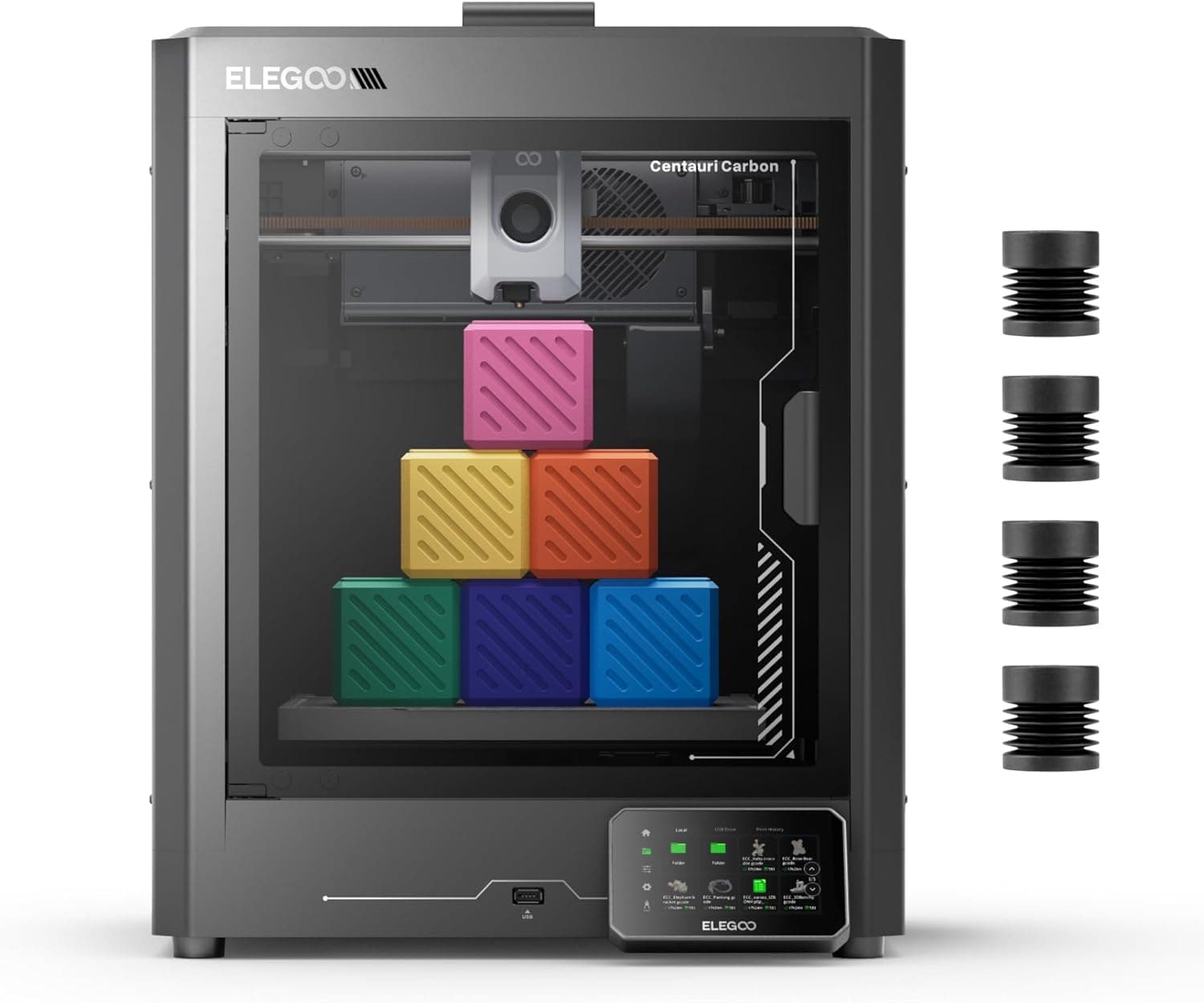
ELEGOO Centauri Carbon with enclosed CoreXY motion, 500mm/s speed and a 320C nozzle for affordable enclosed printing.
Price range: See on Amazon
What we liked
- + 320C nozzle handles ABS, ASA and carbon-filled filaments
- + Enclosed CoreXY design keeps fast prints stable and warm
- + ELEGOO pricing makes an enclosed printer reachable on a tighter budget
Trade-offs
- - No actively heated chamber, so large nylon parts can still warp
- - Newer model with a smaller pool of community tweaks so far
Who this printer fits
The Centauri Carbon is aimed at makers who want the stability of an enclosed CoreXY printer and the ability to print ABS, ASA, and carbon-filled filaments, but at a lower price than premium enclosed machines. ELEGOO's product page and the Amazon listing describe a 320 degree nozzle and a fully enclosed 256 x 256 x 256mm chamber with auto calibration and a built-in camera, aimed at users who want a mostly hands-off setup. That makes it a good fit for hobbyists stepping up from an open-frame PLA printer who want to try tougher materials without a large budget jump. It suits large single nylon parts less well, since the chamber is not actively heated.
Build volume, hotend and bed
ELEGOO's specifications list a 256 x 256 x 256mm build volume with a direct extruder, all-metal hotend, and a hardened steel nozzle rated up to 320 degrees Celsius, high enough for ABS, ASA, and carbon fiber-reinforced filaments. The bed is heated by what ELEGOO describes as a 1000W AC heater reaching up to 110 degrees Celsius, and the printer uses a magnetic, flexible dual-sided plate with textured PEI on one side and a PLA-specific coating on the other. Rated print speed is up to 500mm/s with 20000mm/s squared acceleration, and the CoreXY motion system is fully enclosed rather than open-framed.
Enclosure without active chamber heating
The Centauri Carbon's enclosure is passive rather than actively heated, meaning chamber warmth comes from the heated bed and printing activity rather than a dedicated heater element that holds a target chamber temperature. That is enough to stabilize smaller ABS and ASA parts and to reduce drafts affecting print quality, but it is a meaningful step down from printers with a genuinely heated chamber when printing large nylon or high-warp parts that need sustained ambient heat throughout the whole build. Buyers planning to print big engineering parts regularly should weigh this limitation against the Centauri Carbon's lower price compared with actively heated alternatives.
Software, monitoring and how it compares
ELEGOO's listing includes an AI camera for timelapse recording and remote monitoring, along with Wi-Fi and USB connectivity, and auto leveling that removes most manual calibration steps before a print starts. Against the Bambu Lab P1S, which also passively heats its chamber but carries a more mature software ecosystem and wider AMS compatibility for multi-material work, the Centauri Carbon competes mainly on price rather than on feature depth. Against open-frame printers like the Creality K1, the enclosed design gives the Centauri Carbon a clear edge for ABS and ASA specifically, at some cost in easy access for routine maintenance or hardware modification compared with an open frame that leaves the whole gantry exposed.
Bottom line
The Centauri Carbon is a reasonably priced way to get enclosed CoreXY printing and carbon fiber-filament compatibility without paying for a premium brand name, and its 320 degree nozzle plus auto calibration cover most hobbyist engineering-filament needs without much manual setup. The passive rather than actively heated chamber is the clearest limitation, so buyers planning large nylon parts or heavy warp-prone prints on a regular basis should expect more variable results than a fully heated enclosure would give them. For ABS, ASA, and carbon-filled filament work at a smaller to medium scale, it remains a solid value option worth considering.
Frequently asked questions
Does the Centauri Carbon have a heated chamber?
It has a passive enclosure warmed by the heated bed and printing activity, not an actively heated chamber with its own temperature control.
What is the maximum nozzle temperature?
ELEGOO rates the hardened steel nozzle up to 320 degrees Celsius, suitable for ABS, ASA and carbon fiber-reinforced filaments.
What is the build volume?
ELEGOO lists 256 x 256 x 256mm for the Centauri Carbon.
Can it print nylon reliably?
It can print nylon, but the lack of active chamber heating means large nylon parts are more prone to warping than on a fully heated enclosure.
Prices change often, so check the current price and availability on Amazon.
Check price on AmazonFilament Print Lab may earn a commission from the link above.