Magigoo MO2016 & MPC2018 3D Printer Bed Adhesive Glue Bundle 2-Pack PLA PETG TPU PC Review (2026)
Updated September 21, 2026 · Research-based review
Our verdict
A sensible bundle for anyone who prints both everyday filaments and polycarbonate, pairing Magigoo's all-purpose formula with its dedicated polycarbonate adhesive. If you never print anything tougher than PLA or PETG, the MO2016 bottle alone covers you and the polycarbonate formula will likely sit unused.
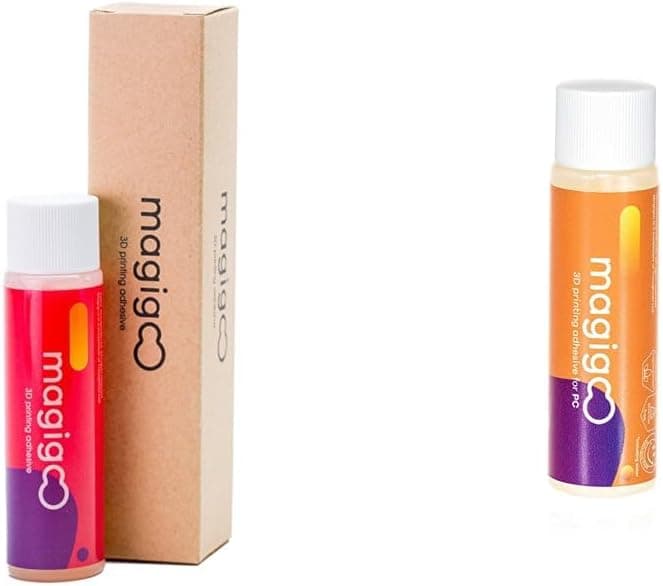
Magigoo MO2016 and MPC2018 bed adhesive glue bundle, a 2-Pack covering PLA, PETG, TPU and PC printing.
Price range: See on Amazon
What we liked
- + MPC2018 formula is aimed at tough polycarbonate adhesion
- + MO2016 covers everyday PLA, PETG and TPU prints
- + Parts release when the bed cools, reducing scraping
Trade-offs
- - Specialty glue costs more than glue sticks or hairspray
- - PC formula is overkill for users who only print PLA
Two adhesives for two different jobs
This bundle pairs Magigoo's MO2016 formula, built for ABS, PLA, PETG, HIPS and TPU, with the MPC2018 formula, which is formulated specifically for polycarbonate filament. Polycarbonate needs notably stronger bed adhesion than standard filaments to resist warping given how much it shrinks as it cools, so a dedicated formula exists rather than expecting one all-purpose glue to handle both jobs equally well. Buying them as a bundle means you are not stuck ordering a second specialty adhesive separately the first time you decide to try printing polycarbonate parts. Each bottle is labeled for its intended filament family, which makes it easy to grab the right one at the start of a print job.
How the adhesive works
Both formulas work on the same principle: shake the bottle, apply a thin coat to the print area before starting a job, and the adhesive grips firmly to the bed while it is hot, then releases cleanly as the bed cools after the print finishes. That temperature-dependent release is what allows parts to come off the bed with light pressure once cooled, rather than needing to be scraped or pried loose while the bed is still warm. Both formulas are described as odorless and non-flammable, which makes them reasonable to use in a home or classroom setting without needing extra ventilation precautions beyond normal workshop practice.
Surface compatibility
Both adhesives are described as working across the build surfaces most commonly used on desktop printers, including glass, PEI, flex plates, Buildtak and Kapton. That broad compatibility is useful if you have swapped build surfaces over time or run different plates on different printers, since you are not locked into using the adhesive only with one specific surface type. As with any bed adhesive, a thin, even coat gives better results than a heavy application, since too much product can leave residue or slightly affect first-layer height. This makes both formulas a reasonable default choice for a shared workshop printer that regularly switches between different plate types and filament materials.
Reapplication and cleanup
Neither formula is a permanent coating, so expect to reapply a fresh coat periodically as prints are removed and the bed is cleaned, particularly after wiping the bed down with water or isopropyl alcohol between prints. This adds a small extra step compared with printing directly on a bare textured PEI sheet that grips without any adhesive at all, but for smooth glass or PEI surfaces that do not grip filament well on their own, a bed adhesive like this is often the difference between reliable first layers and frequent warping or lifted corners. Keeping both bottles within reach of the printer makes this small extra step easy to fold into a normal pre-print routine.
Who should buy the bundle versus a single bottle
This bundle makes the most sense for anyone who already prints, or plans to print, both standard filaments and polycarbonate, since it saves a separate order down the line. If polycarbonate is not on your radar and you mainly print PLA, PETG or ABS, the MPC2018 half of this bundle will likely go unused, and a single bottle of the MO2016 formula alone covers your needs at a lower cost. For makers running a mixed filament shop or shared printer, having both on hand avoids scrambling for the right adhesive mid-project.
Frequently asked questions
What is the difference between MO2016 and MPC2018?
MO2016 is the all-purpose formula for ABS, PLA, PETG, HIPS and TPU, while MPC2018 is formulated specifically for polycarbonate, which needs stronger adhesion to resist warping.
What surfaces does this work on?
Both formulas are described as working on glass, PEI, flex plates, Buildtak and Kapton build surfaces.
Do I need to reapply it for every print?
You generally need to reapply after cleaning the bed with water or alcohol, since the coating is not a permanent surface treatment.
Is this worth buying if I only print PLA?
If you never print polycarbonate, the MPC2018 half of this bundle will likely go unused, and a single bottle of the MO2016 formula alone would cover typical PLA, PETG and ABS printing.
Prices change often, so check the current price and availability on Amazon.
Check price on AmazonFilament Print Lab may earn a commission from the link above.