Creality K1C 3D Printer, up to 600mm/s, Carbon Fiber Printing, Anti-Vibration Review (2026)
Updated September 20, 2026 · Research-based review
Our verdict
This K1C listing suits the same reinforced-filament use case as Creality's other K1C offerings, with anti-vibration tuning aimed at keeping high-speed prints clean. It shares the 220 x 220 x 250mm volume and 300C hotend of Creality's carbon fiber-capable machines, trading some build size for enclosed stability.
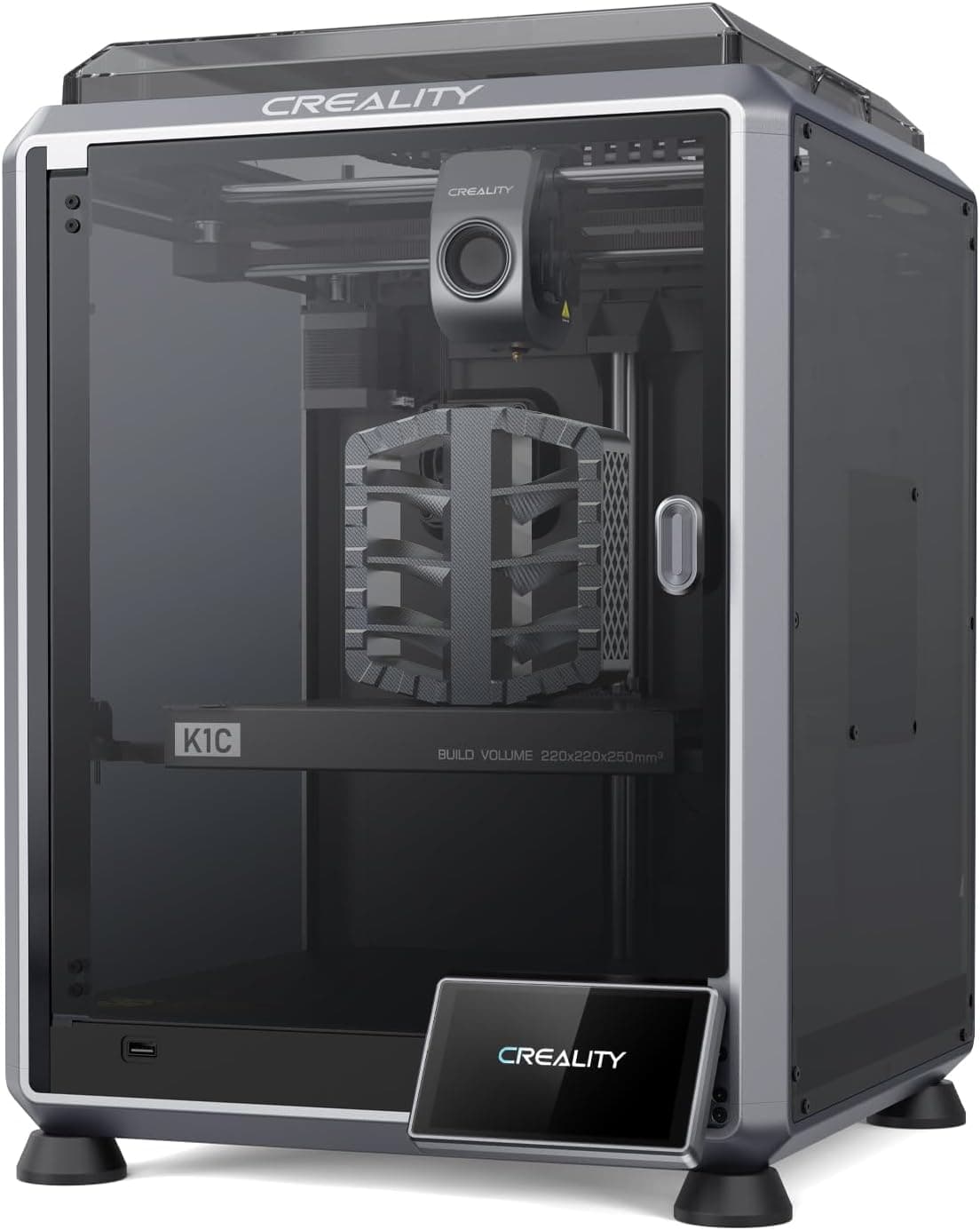
Creality K1C up to 600mm/s with carbon fiber printing and anti-vibration features for stiff, clean high-speed parts.
Price range: See on Amazon
What we liked
- + Anti-vibration tuning reduces ringing when printing at high speed
- + Carbon fiber support opens up rigid engineering-style prints
- + Enclosed design keeps drafts off prints for better consistency
Trade-offs
- - Carbon fiber materials wear standard nozzles, so hardened parts matter
- - Build volume is compact next to Max-class fast printers
Who this printer fits
The K1C is built for makers who want to move past standard PLA and PETG into stiffer, more dimensionally stable parts like drone arms, jigs, or brackets, without assembling a kit machine. Creality's product pages and the Amazon listing describe carbon fiber filament support paired with a hardened steel nozzle tip and a hotend rated to 300 degrees Celsius, which is what makes abrasive reinforced filaments practical rather than something that quickly wears out a brass nozzle. Enthusiasts who batch print functional parts and want speed alongside that capability are the best fit. Anyone who only prints PLA models occasionally, or who wants an open frame for easy modification, would likely find the enclosed body more restrictive than useful.
Speed, build volume and hotend
Creality's official K1C page and multiple retailer listings agree on a 220 x 220 x 250mm build volume with a rated top speed of 600mm/s and 20000mm/s squared acceleration, figures achieved in Creality's own testing under specific conditions rather than as an average for every print. The hotend reaches up to 300 degrees Celsius, and the machine uses an all-metal direct drive extruder with a 0.4mm nozzle, with 0.6mm and 0.8mm nozzles also listed as compatible. Auto leveling is handled by a combination of AI LiDAR first-layer scanning and hands-free calibration, and the build plate itself heats up to 100 degrees Celsius, needed for keeping ABS and carbon-filled filaments flat during a print.
Printing with carbon fiber filament
Creality specifically markets the K1C around carbon fiber-reinforced filament support, which is why it ships with a hardened steel nozzle rather than the brass nozzles common on budget printers, since reinforced filament is abrasive enough to wear brass down quickly. The enclosed CoreXY design also helps keep printing conditions stable, which matters for engineering filaments prone to warping in a drafty room. Carbon-filled filaments do generally cost more than standard PLA and require higher hotend and bed temperatures, both of which this machine is specified to handle. Owners planning to print reinforced materials regularly should budget for periodic nozzle inspection even with the hardened tip, since abrasive filament wear is a matter of degree rather than elimination.
How it compares with other Creality K1 models
Within Creality's own lineup, the K1C sits alongside the standard K1 and the larger K1 Max. The plain K1 shares similar speed and acceleration figures but is not marketed around carbon fiber support in the same way, making the K1C the better pick specifically for reinforced filament work. The K1 Max steps up to a larger build volume for bigger single parts, at a higher price. Against general purpose enclosed printers from other brands, the K1C's combination of an AI LiDAR leveling system and carbon fiber-ready hardware is a specific, use-case-driven advantage rather than a general one.
Bottom line
As with Creality's other K1C listings, this version is built around the same core hardware: a 300 degree hotend, a hardened nozzle for reinforced filament, and an enclosed CoreXY frame rated for 600mm/s. The anti-vibration tuning referenced in this listing is part of keeping that speed usable without visible ringing on the outside of prints. Buyers comparing multiple K1C listings from different sellers should focus on what accessories and warranty support are bundled, since the underlying printer specifications are consistent with Creality's official K1C page. Anyone needing a larger build volume than 220 x 220 x 250mm should look at the K1 Max instead.
Frequently asked questions
Is this K1C the same printer as other K1C listings?
Yes, Creality's official K1C page describes the same core specifications: 220 x 220 x 250mm build volume, 300 degree hotend, and carbon fiber filament support, across its listings.
What does anti-vibration tuning do on the K1C?
It helps reduce visible ringing artifacts on prints when the machine runs near its rated 600mm/s top speed.
Does the K1C come pre-calibrated?
Creality markets the K1C as pre-assembled and pre-calibrated with AI LiDAR-based auto leveling out of the box.
What nozzle sizes does the K1C support?
It ships with a 0.4mm nozzle, with 0.6mm and 0.8mm nozzles also listed as compatible by Creality.
Prices change often, so check the current price and availability on Amazon.
Check price on AmazonFilament Print Lab may earn a commission from the link above.