SUNLU Silk Dual Color PLA Filament 1.75mm, Shiny Silk Texture, 1KG, Black Blue Review (2026)
Updated September 20, 2026 · Research-based review
Our verdict
A good fit for display prints where a single spool should show off two colors, like vases, dragons or ornaments that get viewed from different angles. The main strength is the black-to-blue shift and PLA+ toughness; the main trade-off is that the effect depends on model shape and orientation, so plain flat surfaces will not show it well.
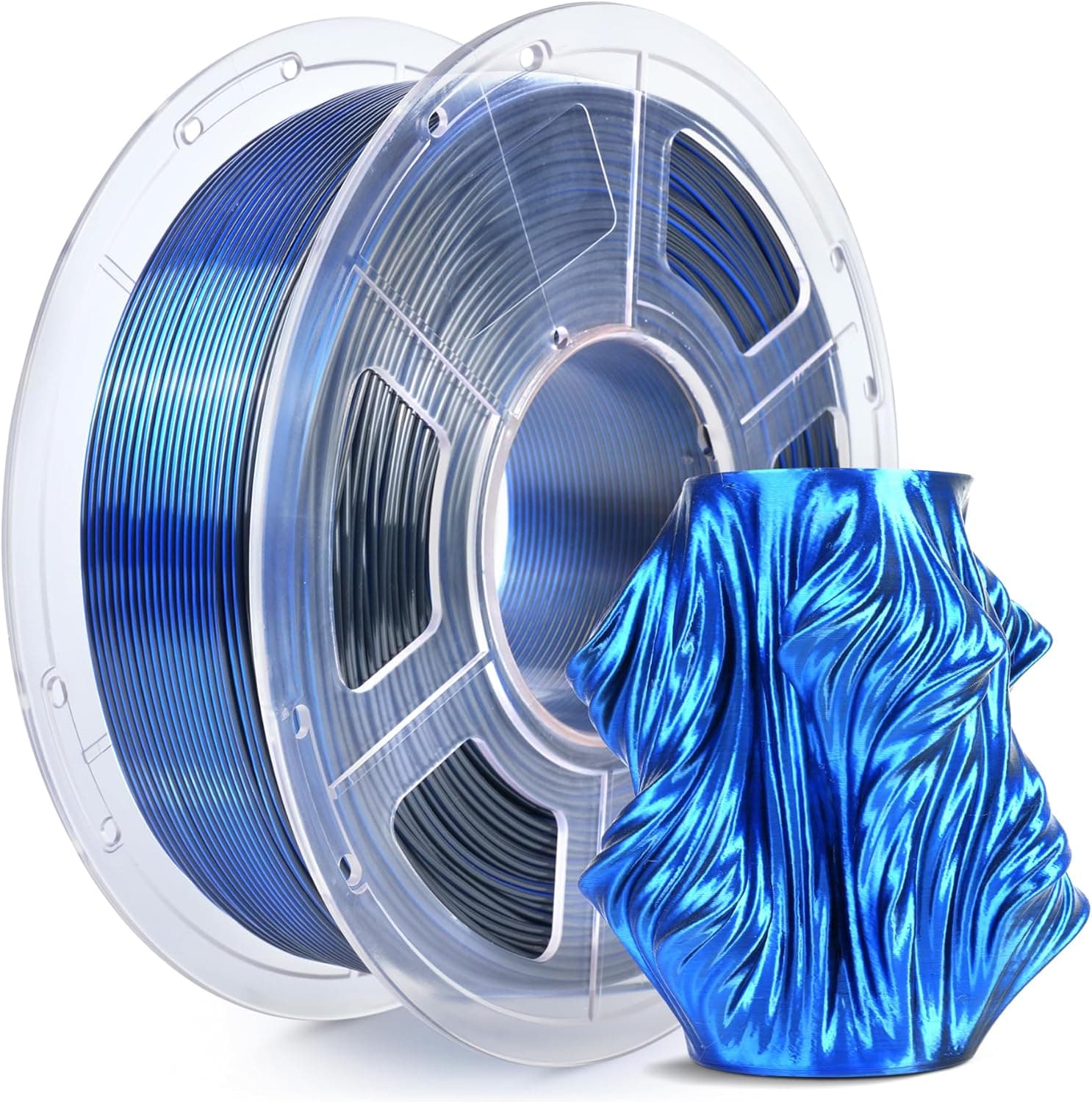
SUNLU Silk Dual Color PLA in black and blue, a 1.75mm 1KG shiny silk filament that shifts color by viewing angle.
Price range: See on Amazon
What we liked
- + Dual color black and blue shifts tone as models rotate in light
- + Creates multi-color looks without a multi-material printing system
- + Shiny silk texture suits vases, dragons and display pieces
Trade-offs
- - Color effect depends on model orientation and wall layout
- - Dual color strands make patching failed prints look mismatched
What this filament is
This is SUNLU's Silk PLA+ Dual Color in black and blue, a 1.75mm filament on a 1KG spool with a shiny silk finish rather than the flat matte look of standard PLA. It is built around SUNLU's PLA+ formula, which the brand markets as tougher than regular PLA, combined with a dual-color strand so a single spool prints two colors depending on how light hits the surface and how the model is oriented on the plate. That makes it a filament aimed squarely at display pieces, art prints and gifts rather than purely functional parts, since the visual effect is the main selling point. Buyers wanting a single flat color for a functional bracket or enclosure are better served by a standard matte PLA or PETG spool.
The dual color, silk-shift effect
SUNLU describes the effect as a 360-degree rotation that unveils varied colors as the print or the viewer turns, so a vase or figurine can look mostly black from one side and shift toward blue from another. This works because the strand itself carries both colors, and how much of each shows up in a given layer depends on the print's geometry, wall count and orientation on the bed. Tall, curved or faceted shapes with distinct planes tend to show the two-tone shift more clearly than a flat plaque or a mostly cubic model. Anyone chasing a specific color pattern should expect some trial and error with orientation, since the result is not fully predictable the way a single solid color would be.
Toughness and print quality
Because this is a PLA+ formulation rather than plain PLA, SUNLU markets it as significantly tougher than standard PLA, with better resistance to snapping under flex or impact. That extra toughness is a genuine advantage for larger prints or thin features like dragon wings or vase rims that would otherwise be prone to cracking. The filament ships on a machine-wound spool that SUNLU describes as tangle-free, which matters for a silk-finish filament since these formulas can sometimes be more prone to stringing and oozing than matte PLA. Print quality on silk filaments generally rewards slightly slower speeds and good cooling to keep the glossy surface smooth rather than textured.
Dimensional accuracy and compatibility
SUNLU lists a diameter tolerance of plus or minus 0.02mm on the 1.75mm strand, which is a tight spec that should feed reliably through most direct-drive and Bowden extruders without frequent jams. The 1KG spool is sized to fit almost all consumer FDM printers built around 1.75mm filament, and SUNLU's own description calls it suitable for essentially any 1.75mm FDM machine rather than a specific brand. As with most silk filaments, expect a glossier, less matte surface than standard PLA, which can make fingerprints and dust more visible on finished prints, so display pieces may benefit from a light dusting or display case if they will sit out for a long time.
Where it fits versus repairs and patch prints
The dual-color strand is a strength for a finished piece, but it becomes a minor annoyance if a print fails partway through and needs a patch or a re-print of one section, since matching the exact color transition point on a second attempt is close to impossible. That is a reasonable trade-off for most users buying this filament specifically for its two-tone look, but it is worth knowing before starting a long, detail-heavy print where a partial failure is likely. For shorter prints or pieces where any mismatch would be hidden, this is a small concern; for large single-piece display prints, printing with reliable bed adhesion and calibrated retraction reduces the odds of needing a mid-print fix.
Frequently asked questions
Does the dual color pattern look the same on every print?
No. The black-to-blue shift depends on the model's shape and how it sits on the bed, so the same spool can look different across models.
Is this regular PLA or PLA+?
It is SUNLU's Silk PLA+ line, which the brand markets as tougher than standard PLA rather than a plain silk PLA.
What diameter tolerance does this filament have?
SUNLU lists a tolerance of plus or minus 0.02mm on the 1.75mm strand.
Is silk PLA harder to print than matte PLA?
It is not dramatically harder, but slightly slower speeds and good cooling help keep the glossy silk surface smooth rather than textured.
Prices change often, so check the current price and availability on Amazon.
Check price on AmazonFilament Print Lab may earn a commission from the link above.