BIGTREETECH SFS V2.0 Smart Filament Sensor, Support Klipper/Marlin/RRF, SKR Mini E3/Octopus Review (2026)
Updated September 20, 2026 · Research-based review
Our verdict
A small motion-based filament sensor for Klipper, Marlin or RRF that catches both empty spools and clogs, not just runouts. The strength is firmware and board compatibility with SKR Mini E3 and Octopus boards. The trade-off is that stock printer boards outside that ecosystem may need adapter wiring to connect it.
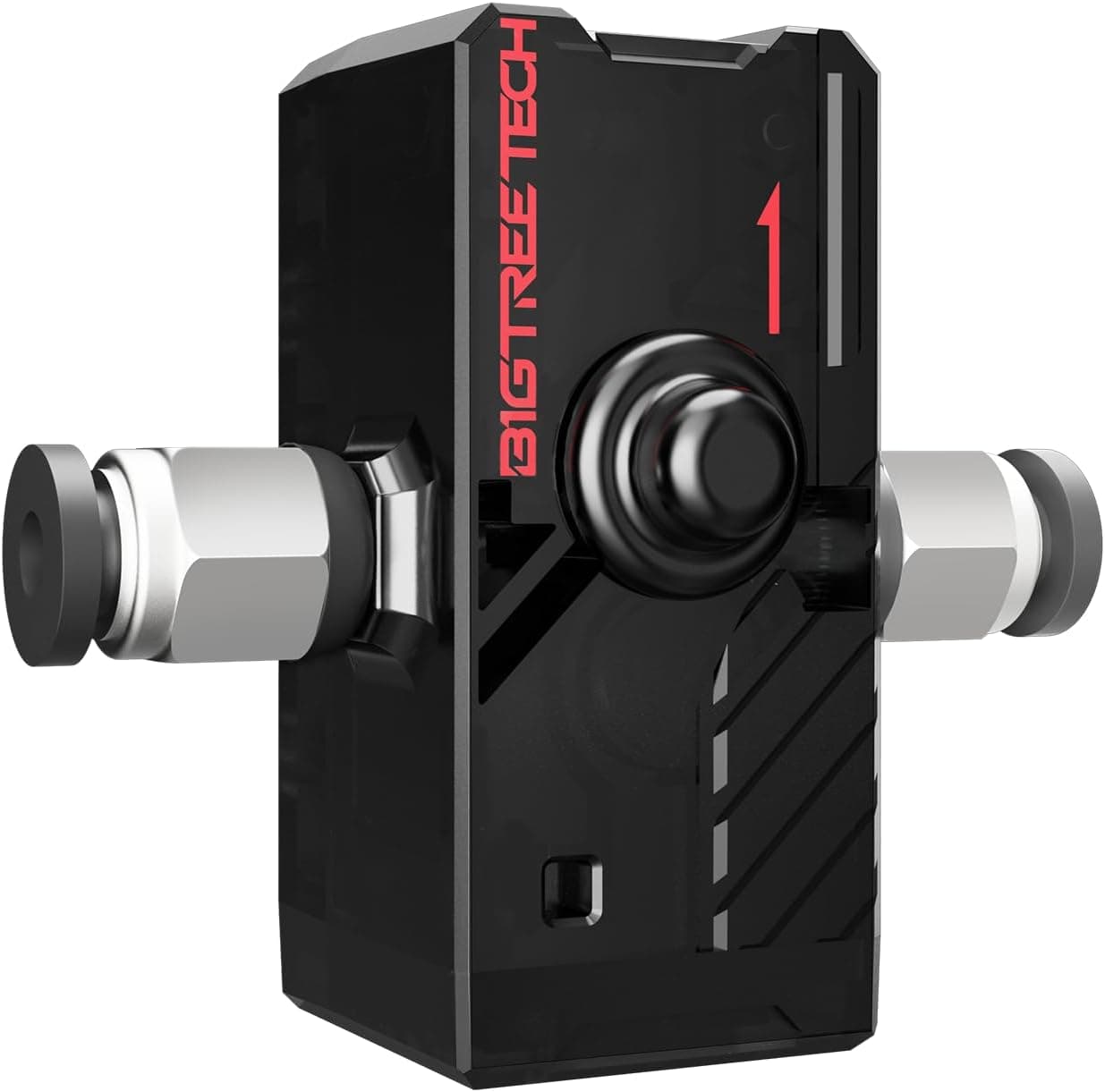
BIGTREETECH SFS V2.0 smart filament sensor supporting Klipper, Marlin and RRF with SKR Mini E3 and Octopus boards.
Price range: See on Amazon
What we liked
- + Klipper, Marlin and RRF support fits almost any firmware setup
- + Plugs easily into SKR Mini E3 and Octopus sensor ports
- + Motion-based detection catches clogs as well as empty spools
Trade-offs
- - Stock printer boards may need adapter wiring to connect
- - Sensitivity settings require tuning to avoid nuisance pauses
What This Sensor Does
The SFS V2.0 is a compact filament sensor that goes beyond a simple runout switch. It uses an encoder wheel paired with a pulley and a micro switch to physically track filament movement, which means it can detect a clog or a jam where filament stops feeding even though a spool is still loaded, not only a fully empty spool. Two separate signal outputs let the printer's firmware tell the difference between a runout and a clog, and onboard indicator lights mirror that status so a quick glance at the sensor shows what triggered a pause. It is designed for 1.75mm filament and works with both Bowden and direct drive extruder setups.
Firmware and Board Compatibility
BIGTREETECH documents support for RRF, Klipper and Marlin, which covers the three firmware families most commonly run on modern DIY and upgraded 3D printers. It is built to plug easily into BIGTREETECH's own SKR Mini E3 and Octopus control boards, which use the same connector standard as the sensor, and mounting brackets for common frames like Ender 3 variants and Voron 2.4 are published as downloadable STL files for 3D printing a bracket. Printers running stock manufacturer boards that use a different connector or pinout for filament sensors may need an adapter cable or some rewiring to connect the sensor's signal wires correctly.
Size, Build and Sensitivity
At about 53 by 30 by 27mm and 36 grams, the sensor is small enough to mount close to the extruder without adding much bulk to the toolhead or frame, and it comes with three mounting holes on the back for bracket installation. It runs on 3.3 to 5V logic, matching the sensor rail voltage on most modern control boards. Because detection relies on a mechanical encoder tracking small amounts of filament movement, with a rated detection length around 2.88mm, the sensitivity threshold sometimes needs tuning in firmware to avoid false pauses on filaments that feed slightly unevenly, such as some flexible materials.
Operating Range and Reliability
The sensor is rated to work between minus 10 and 50 degrees Celsius with 10 to 90 percent humidity tolerance, a range wide enough for most home workshop and garage printing setups without special conditioning. Bi-directional operation means it does not care which way filament threads through it, simplifying installation compared to sensors that only work in one orientation. Because it is a mechanical encoder rather than a purely optical break sensor, it tends to catch feeding problems that optical sensors miss, such as filament that is still present but has stopped advancing due to a tangle on the spool or a partial nozzle clog.
Who Should Buy It
This sensor fits printer owners already running Klipper, Marlin or RRF who want more protection than a basic runout switch, particularly for long unattended prints where a silent clog can waste as much filament and time as a fully empty spool. It is a natural add-on for anyone already using BIGTREETECH SKR Mini E3 or Octopus boards, since the wiring and firmware macros are well documented for that combination. Owners of stock manufacturer boards should confirm their sensor port pinout first, since some rewiring or an adapter may be needed before the sensor can report correctly to the printer's firmware.
Frequently asked questions
Does the SFS V2.0 detect clogs, not just runouts?
Yes. It uses an encoder and micro switch to track filament motion, so it can flag a clog or jam even when filament is still loaded on the spool, in addition to a full runout.
What firmware does it support?
BIGTREETECH documents support for Klipper, Marlin and RRF, covering the firmware families most commonly used on upgraded and DIY 3D printers.
Will it plug straight into my stock printer board?
It connects easily to BIGTREETECH's own SKR Mini E3 and Octopus boards; other manufacturer boards may need adapter wiring since sensor port pinouts vary.
Does it work with both Bowden and direct drive extruders?
Yes, the sensor is designed to work with either extruder type and is bi-directional, so filament direction through it does not matter.
Prices change often, so check the current price and availability on Amazon.
Check price on AmazonFilament Print Lab may earn a commission from the link above.