Polymaker Carbon Fiber PLA Filament 1.75mm PolyLite PLA-CF Reinforced Matte Black 1kg Review (2026)
Updated September 20, 2026 · Research-based review
Our verdict
Best suited to makers who want stiffer brackets, mounts or drone frames with a clean matte black look, and are willing to swap in a hardened nozzle. The main strength is Polymaker's consistent carbon fiber PLA; the trade-off is that the fibers are abrasive and parts turn out stiffer but more brittle under impact.
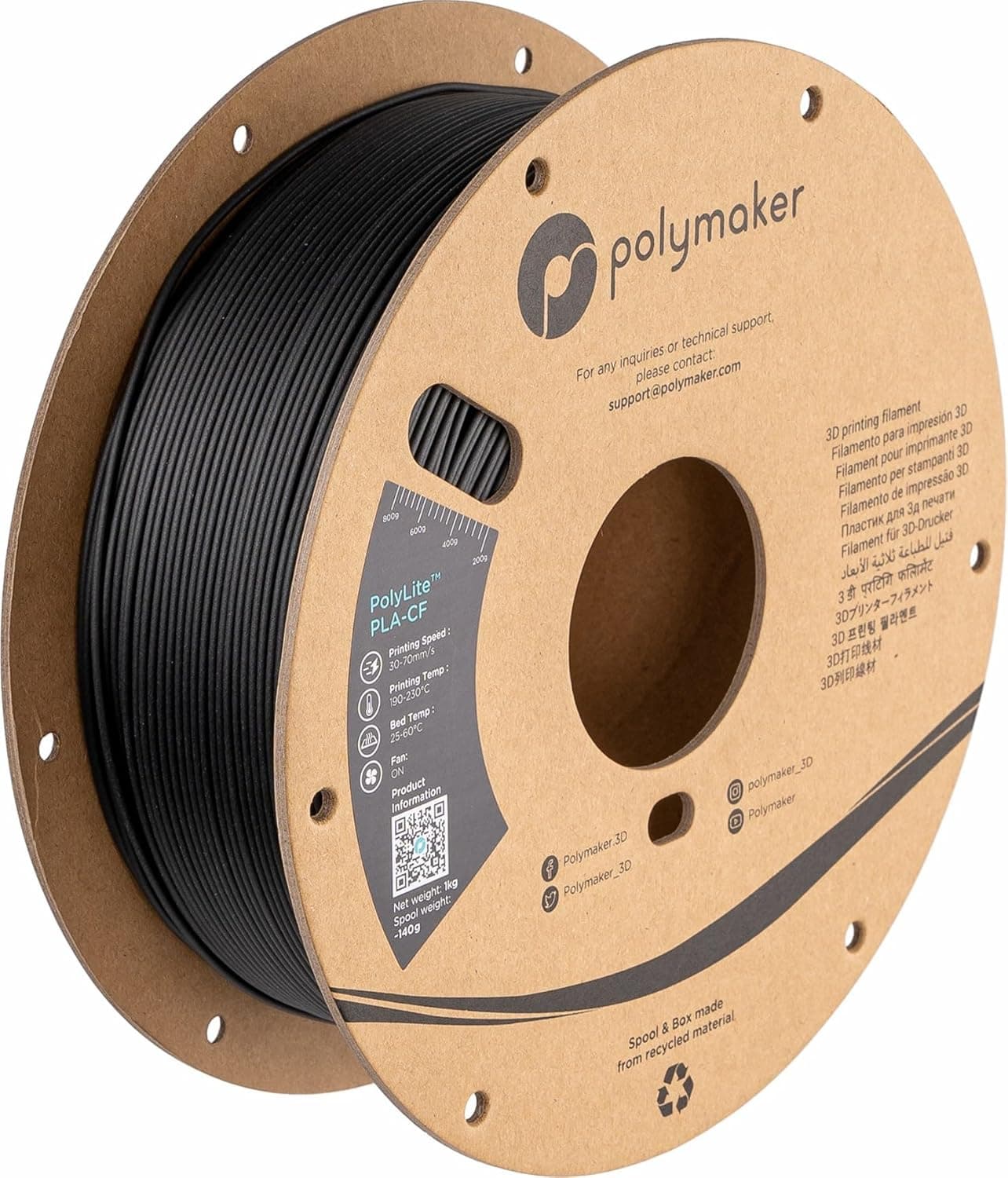
Polymaker PolyLite PLA-CF in matte black, a carbon fiber reinforced 1.75mm 1kg filament for stiff, clean-looking parts.
Price range: See on Amazon
What we liked
- + Carbon fiber reinforcement adds stiffness to brackets and mounts
- + Matte black finish hides layer lines for a professional look
- + Polymaker quality control gives consistent results spool to spool
Trade-offs
- - Abrasive fibers call for a hardened nozzle to avoid wear
- - Stiffer parts are more brittle and less impact tolerant than PETG
What this filament is
This is Polymaker's PolyLite PLA-CF, a carbon fiber reinforced PLA on a 1.75mm, 1kg spool in matte black. Polymaker's own listing describes it as roughly 8 percent chopped carbon fiber by weight blended into a PLA base, which is what gives the finish its dry, matte look and gives printed parts extra stiffness compared with unfilled PLA. It is aimed at functional parts that need to resist bending or flexing under load, such as brackets, jigs, tool holders and drone or RC frames, rather than parts that need to survive drops or repeated flexing. For anything that needs to bend or absorb shock instead of staying rigid, a tougher unfilled filament or a PETG blend is a better match.
Stiffness versus impact resistance
Carbon fiber reinforcement adds real stiffness, which is why this filament suits mounts, brackets and enclosures that need to hold their shape under load without sagging or flexing. The trade-off that comes with any chopped-fiber filament is reduced impact tolerance: the short fibers can act as stress points, so a carbon fiber PLA part is more likely to crack under a sharp impact than an equivalent part in plain PLA or PETG, even though it resists bending better under a steady load. That makes this filament a strong choice for rigid structural pieces and a weaker choice for anything that might get dropped or knocked around, where a tougher unfilled material would hold up better.
Nozzle wear and print settings
Because the carbon fiber particles are abrasive, Polymaker and most printer communities recommend a hardened steel nozzle rather than a stock brass one, since the fibers gradually wear away the softer brass over repeated spools. Polymaker's guidance lists a nozzle temperature in the 190C to 230C range with printing commonly run around 220C, a bed temperature between 25C and 60C, and a suggested print speed near 50mm/s, with the part cooling fan turned off for the first layer to help bed adhesion. These are all achievable on most standard FDM printers, but the hardened nozzle is worth budgeting for separately if the printer only ships with a brass one, since skipping it shortens nozzle life.
Finish, tolerance and storage
Polymaker lists a dimensional accuracy of plus or minus 0.03mm on the 1.75mm strand, and the matte black finish is genuinely good at hiding layer lines, which gives finished parts a more finished, professional look straight off the printer without much post-processing. Like most carbon fiber and other filled filaments, PLA-CF is more sensitive to moisture than plain PLA, and a humid spool can cause popping, stringing or a rougher surface finish during printing. Polymaker recommends storing it in the resealable bag it ships in between print sessions rather than leaving it exposed on the printer, which matters more in humid climates than dry ones.
How it compares to ELEGOO's carbon fiber PLA
The closest rival in this category is ELEGOO's PLA-CF, which is priced more accessibly and carries a tighter published tolerance of plus or minus 0.02mm against Polymaker's 0.03mm. Polymaker's advantage is its longer track record for consistent spool-to-spool quality control, which matters on longer prints where a batch-to-batch color or diameter shift could cause a failure partway through. Buyers on a tighter budget or printing smaller parts where minor tolerance differences matter less may find ELEGOO's option the better value, while those who have had inconsistent filament from other budget brands in the past may prefer paying more for Polymaker's reputation.
Frequently asked questions
Do I need a hardened nozzle for this filament?
Yes, it is recommended. The carbon fiber content is abrasive and will gradually wear down a standard brass nozzle.
What print settings does Polymaker recommend?
Polymaker lists a nozzle range of 190C to 230C, a bed temperature of 25C to 60C, and turning the cooling fan off for the first layer.
Is carbon fiber PLA more brittle than regular PLA?
It is stiffer under steady loads but more prone to cracking under a sharp impact than unfilled PLA, since the chopped fibers can create stress points.
How should I store this filament between prints?
Polymaker recommends resealing it in its original bag, since carbon fiber PLA is more sensitive to moisture than plain PLA.
Prices change often, so check the current price and availability on Amazon.
Check price on AmazonFilament Print Lab may earn a commission from the link above.