Polymaker ABS Filament Black 1KG 1.75mm, Heat Resistant, High Toughness Review (2026)
Updated September 20, 2026 · Research-based review
Our verdict
Good pick for makers who need ABS parts that survive heat and impact, like under-hood clips or electronics housings. The main strength is Polymaker's heat-resistant, tightly toleranced formula; the main trade-off is a higher price than budget ABS brands and the ventilation ABS printing generally calls for.
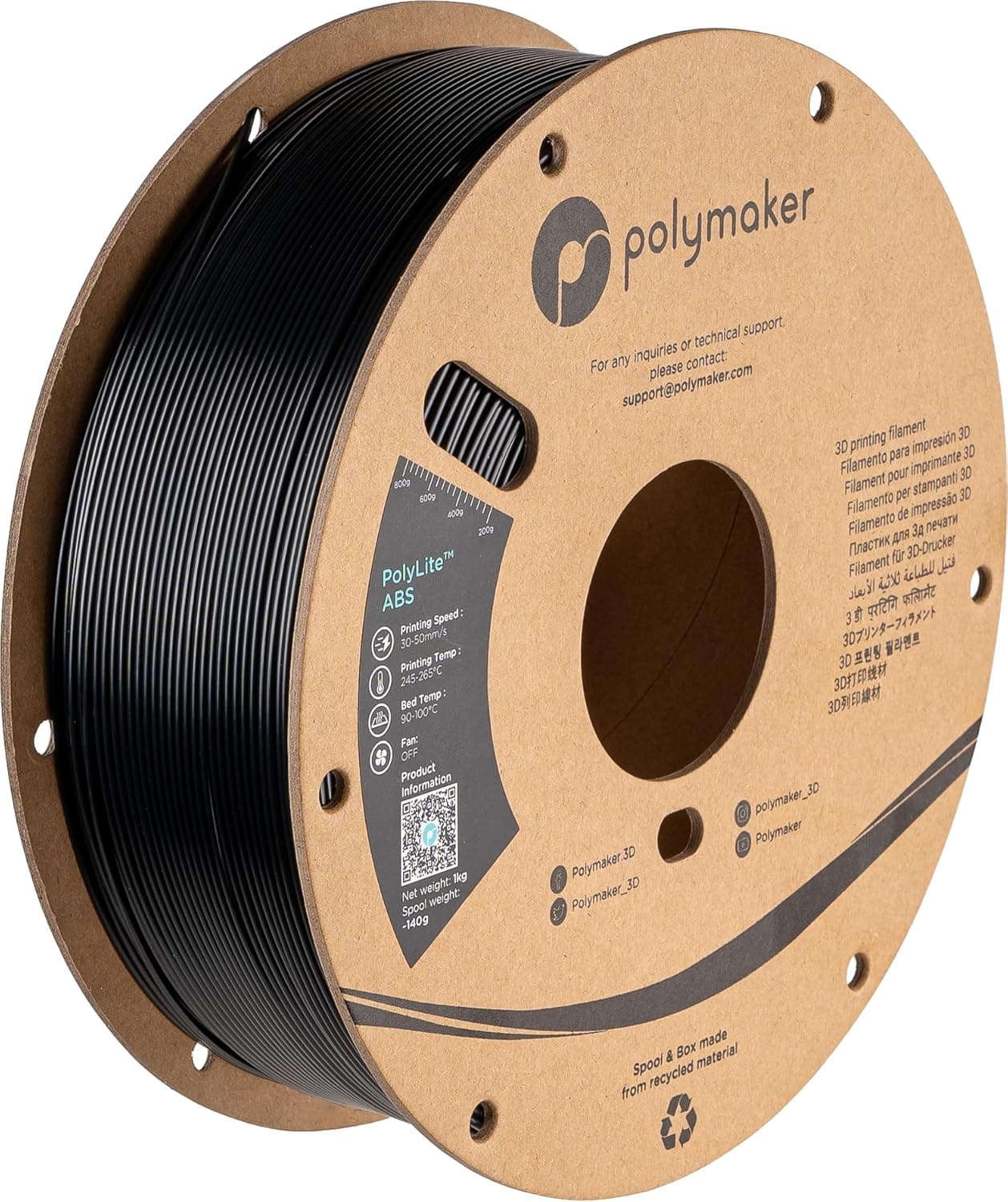
Polymaker black ABS on a 1KG spool of 1.75mm, marketed as heat resistant with high toughness for durable parts.
Price range: See on Amazon
What we liked
- + High toughness helps parts survive impacts and repeated handling
- + Heat resistant ABS suits under-hood clips and electronics housings
- + Polymaker quality control gives reliable spool-to-spool behavior
Trade-offs
- - Premium price over SUNLU and other budget ABS options
- - Produces odor and fine particles, so filtered enclosures help
What this filament is for
This is Polymaker's PolyLite ABS in black, a 1.75mm filament sold on a 1KG spool and built for functional parts rather than display pieces. Polymaker markets it as heat resistant and high in toughness, and the manufacturer's own data sheet backs that up with a Vicat softening temperature of 104C and a heat deflection temperature near 99C, which is high for a consumer ABS. That makes it a reasonable choice for parts that sit near warm components, such as clips, brackets and housings for electronics that get slightly warm in normal use. ABS also machines and sands well after printing, so parts that need drilling, filing or acetone vapor smoothing are easier to finish than with PLA. If the goal is a print that only needs to look good on a shelf, a PLA or PETG filament will be simpler to run.
Heat resistance and mechanical toughness
The heat figures from Polymaker's data sheet, a Vicat softening point of 104C and a heat deflection temperature around 99C, sit above most PLA and many PETG filaments, which typically soften well under 70C. That gap is the reason ABS remains a common choice for parts near heat sources or for anything that could sit in a hot car. Polymaker also describes the resin as bulk polymerized for better mechanical strength and durability than some standard ABS pellets, which lines up with the toughness the product listing highlights for parts that take impacts or repeated handling, like enclosures that get opened and closed. Buyers should still expect ABS to be less impact tolerant than nylon or TPU blends, so this filament suits rigid functional parts more than anything that needs to flex.
Printing settings and dimensional accuracy
Polymaker lists a nozzle temperature range of 245C to 265C and a bed temperature of 90C to 100C for this ABS, both higher than typical PLA settings, so an all-metal hotend and a bed that can actually reach that range matter before buying. The filament carries a published diameter tolerance of plus or minus 0.03mm, which is a middle-of-the-road spec rather than the tightest on the market but should still feed consistently through a well calibrated extruder. Because ABS shrinks as it cools, an enclosure or at least a draft-free room helps reduce warping and corner lifting, especially on larger flat prints. A heated bed with strong first-layer adhesion, such as a glue stick or specialty surface, is worth pairing with this filament for reliable results.
Odor, fumes and ventilation
Polymaker describes this ABS as made from a specialty bulk-polymerized resin with lower volatile content than traditional ABS pellets, and states it prints with minimal odor compared to standard ABS. That is a real formulation difference, but it does not make ABS odor free as a material class. Styrene-based filaments still release some fumes and ultrafine particles when heated to the 245C to 265C range this filament calls for, so printing in a ventilated room or using an enclosure with a carbon filter is still sensible, particularly for long prints or shared spaces. Anyone sensitive to smell or printing near living areas should treat this as lower odor ABS rather than odorless, and plan ventilation accordingly rather than skipping it because the listing mentions reduced odor.
Price and how it stacks up against rivals
Polymaker's ABS sits at a premium over budget options such as SUNLU's multi-spool ABS packs and HATCHBOX ABS, both of which are commonly priced lower per kilogram. The trade-off buyers are paying for is Polymaker's tighter quality control and more consistent spool-to-spool behavior, which matters more on parts where warping or brittle layers would ruin a long print. For occasional prints where any ABS will do, a cheaper multi-pack may be the more practical buy. For functional parts that need predictable heat resistance and toughness, the price premium is easier to justify since a failed long print in cheaper filament often costs more in time than the difference in spool price.
Frequently asked questions
What nozzle and bed temperature does this ABS need?
Polymaker recommends a nozzle temperature of 245C to 265C and a bed temperature of 90C to 100C for this filament.
Does this ABS need an enclosure to print well?
An enclosure is not strictly required but helps reduce warping on larger parts, since ABS shrinks as it cools; at minimum, print away from drafts.
Is this filament less smelly than regular ABS?
Polymaker formulates it with lower volatile content for reduced odor, but it still benefits from a ventilated space since ABS as a class releases fumes when heated.
How does it compare to PETG for toughness?
This ABS is tuned for heat resistance and impact toughness in rigid parts, while PETG generally offers easier printing and better outdoor UV tolerance but softens at a lower temperature.
Prices change often, so check the current price and availability on Amazon.
Check price on AmazonFilament Print Lab may earn a commission from the link above.