OVERTURE High Speed TPU 95A Flexible Filament 1.75mm, 1kg Black Review (2026)
Updated September 14, 2026 · Research-based review
Our verdict
A 95A high speed TPU for direct drive printers that want flexible parts without settling for the crawling speeds standard TPU usually needs. Tight tolerance and pre-dried, vacuum-sealed packaging help it feed consistently, but real speed still depends on a tight filament path, and long Bowden tubes remain a weak point.
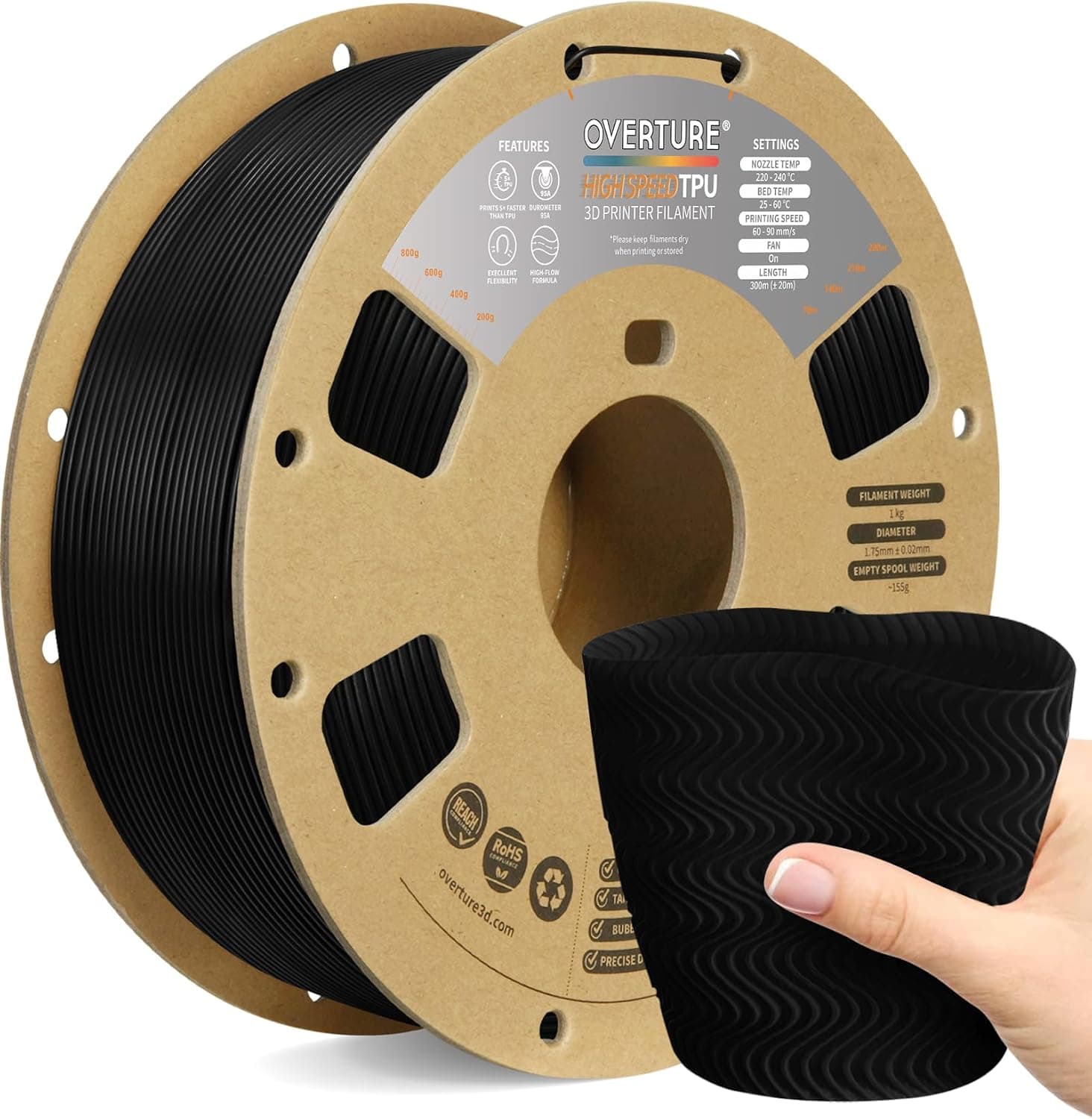
OVERTURE High Speed TPU 95A in black, a flexible 1.75mm filament on a 1kg spool for quicker flexible prints.
Price range: See on Amazon
What we liked
- + High speed TPU lets direct drive printers run flexibles without crawling
- + Black 95A TPU is a practical pick for grips, feet and cable guards
- + OVERTURE spools are neatly wound, which helps flexible feeding
Trade-offs
- - Speed claims still depend on a tight filament path in the extruder
- - Soft filament can buckle in long Bowden tubes and cause jams
Who OVERTURE's high speed TPU suits
This filament is aimed at printer owners who already have a direct drive extruder and want to add flexible parts, phone cases, grips, gaskets and cable guards, without the usual patience TPU demands at slow speeds. The 95A hardness lands in the firmer middle of the TPU range, stiff enough to hold detail on small functional parts while still bending and compressing where flexibility matters. OVERTURE markets it specifically as printing faster than standard TPU with claimed jam-free performance at higher speeds, which appeals most to people who print flexible parts regularly rather than as a rare novelty. Bowden printer owners can still use it, but should expect to tune speed and retraction down from the high speed claims made for direct drive setups.
What the packaging and spec sheet promise
OVERTURE states this filament prints at a relatively low 210 to 230C nozzle temperature with a suggested print speed around 20 to 40mm/s, a figure that is still meaningfully faster than the crawl often needed for older TPU formulations, alongside a dimensional accuracy rating of +/- 0.03mm that helps reduce the diameter swings that jam flexible filament in an extruder. The spool ships pre-dried for 24 hours before packaging and then vacuum-sealed with desiccant, since TPU absorbs moisture readily and prints worse once damp. OVERTURE also describes a clog-free patent technology aimed at the extrusion process itself, though the practical benefit of that claim will vary by printer and hotend rather than being certain on every setup.
Using it in practice
As with any TPU, a short, constrained filament path from extruder gears to hotend matters more than nozzle temperature for avoiding jams, so a direct drive extruder gets closer to OVERTURE's speed claims than a Bowden setup with a long tube for the filament to buckle in. Lowering or disabling retraction is standard practice with flexible filament, since retracting soft material tends to cause skips or grinding rather than clean retraction. If prints start showing stringing, small bubbles or a rough surface after the spool has been open a while, a stint in a filament dryer typically restores quality, since TPU picks up ambient moisture faster than rigid filaments like PLA. Bed adhesion is described as good with low warp, which matters because flexible parts can lift at the edges if adhesion is marginal.
How it compares with rival TPU filaments
The site scores this evenly with SUNLU's high speed 95A TPU, and the two are close enough on hardness and tolerance that spool winding consistency and price at the time of purchase often decide between them. Polymaker's PolyFlex TPU95 ranks slightly higher and adds claimed UV resistance useful for parts that will live outdoors, but comes on a smaller 0.75kg spool at a higher cost per gram than this 1kg OVERTURE spool. A standard, non-high-speed OVERTURE TPU sits lower in the ranking, a reasonable downgrade for anyone who does not need the faster print speed and wants to save a little on cost.
Verdict on this TPU filament
This is a sensible choice for a direct drive printer owner who wants to print flexible parts faster than traditional TPU allows, and the pre-drying and vacuum sealing reduce one of the more common causes of poor TPU prints straight out of the box. It performs best when paired with a tuned retraction profile and, ideally, a direct drive setup, since Bowden printers will not see the full benefit of the high speed formulation. Anyone printing flexible parts for prolonged outdoor use should weigh Polymaker's PolyFlex instead, since UV stability matters more there than the modest price difference.
Frequently asked questions
Is this TPU suitable for a Bowden extruder?
It can be printed on a Bowden setup, but flexible filament performs more reliably on a direct drive extruder, and Bowden users typically need slower speeds and reduced retraction to avoid jams.
What nozzle temperature does this filament need?
OVERTURE recommends a nozzle temperature of about 210 to 230C for this TPU, which is a fairly standard range for 95A flexible filament.
Does this TPU come pre-dried?
Yes, it is described as dried for 24 hours before packaging and then vacuum-sealed with desiccant to keep moisture out until the spool is opened.
How firm is 95A TPU compared with softer grades?
95A sits toward the firmer end of common TPU hardness ratings, holding detail and shape better than softer 85A to 90A TPU while still flexing enough for cases, grips and gaskets.
Prices change often, so check the current price and availability on Amazon.
Check price on AmazonFilament Print Lab may earn a commission from the link above.