BIGTREETECH SKR Mini E3 V2.0 Control Board 32Bit Silent, TMC2209 UART, Ender 3/V2/Pro/5 Review (2026)
Updated September 21, 2026 · Research-based review
Our verdict
A solid, budget-friendly upgrade for anyone still running a noisy stock Ender-series mainboard. The main strength is quieting stepper motors with UART-driven TMC2209 drivers on a well-documented board; the main trade-off is that BIGTREETECH has since released a newer Mini E3 revision that supersedes this one.
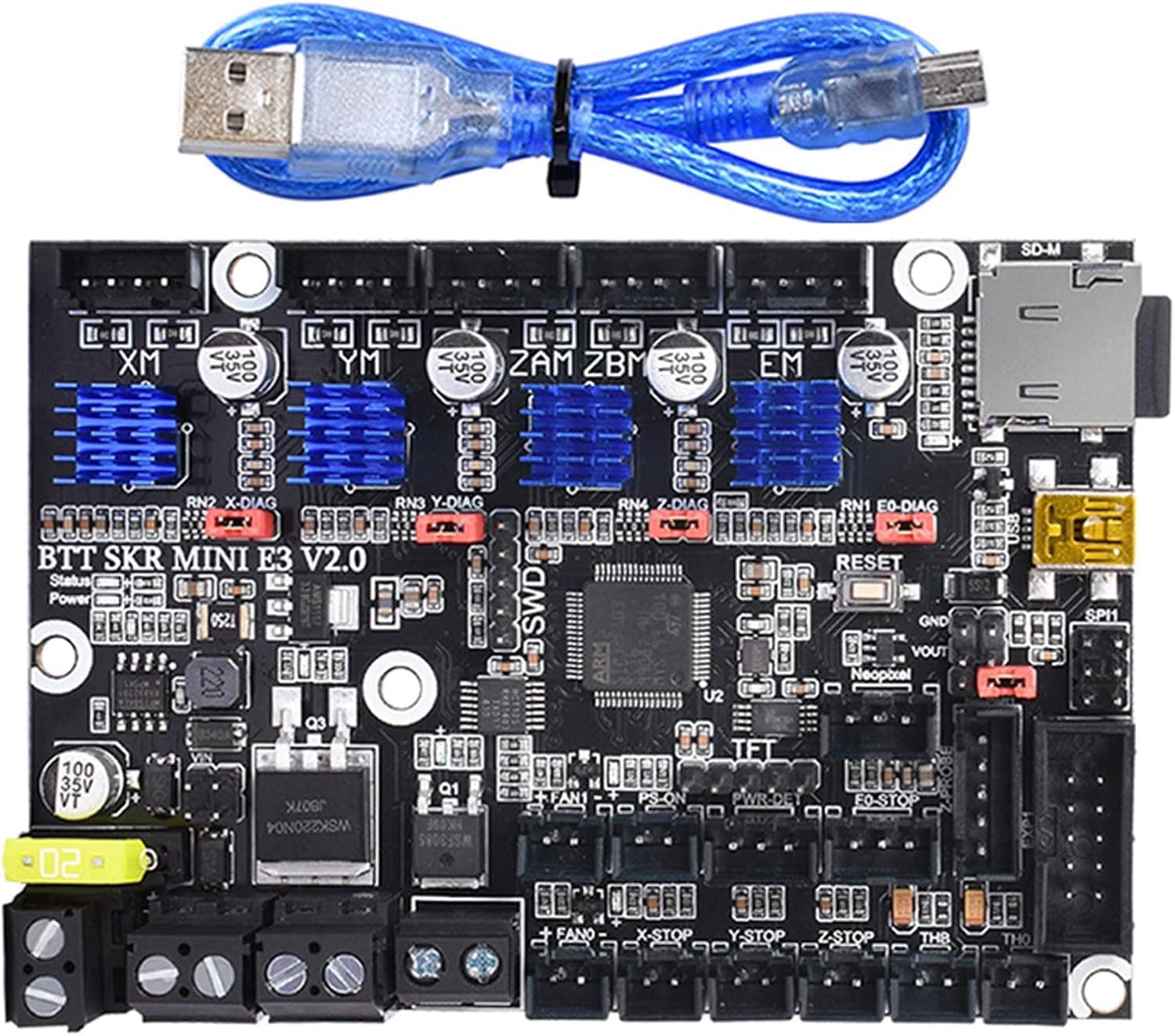
BIGTREETECH SKR Mini E3 V2.0 32Bit silent control board with TMC2209 UART drivers for Ender 3, V2, Pro and 5.
Price range: See on Amazon
What we liked
- + TMC2209 UART drivers quiet down loud stock Ender steppers
- + Fits Ender 3, V2, Pro and Ender 5 mounting without adapters
- + Popular board with lots of setup guides and firmware builds
Trade-offs
- - Older V2.0 revision has been superseded by the newer Mini E3 revision
- - Probe and screen connections may need adapters on some models
What this board is
The SKR Mini E3 V2.0 is a 32-bit control board built around an STM32F103RCT6 microcontroller with 256K of flash memory, designed as a drop-in mainboard replacement for Creality's Ender 3, Ender 3 Pro, Ender 3 V2 and Ender 5 printers. It runs on 12 or 24 volt DC input with 3.3V logic, matching the power supplies already fitted to those printers, so installation generally does not require sourcing a different power supply. The board integrates TMC2209 stepper drivers directly onto the board itself rather than requiring separate plug-in driver modules, simplifying the upgrade compared with boards that need drivers purchased and installed separately.
Quieter printing with TMC2209 UART drivers
The onboard TMC2209 drivers run in UART mode, which enables StealthChop2 silent stepping technology that meaningfully reduces stepper motor noise compared with the stock drivers found on many Ender-series printers out of the box. UART mode also allows for more advanced driver configuration, such as adjusting current and microstepping through firmware settings rather than physical potentiometers, and it supports sensorless homing through StallGuard on printers wired to take advantage of it. For anyone whose main complaint about a stock Ender printer is stepper motor whine or general operating noise, this driver upgrade is one of the more effective and commonly recommended fixes, often noticeable from the very first print after installation.
Features beyond quiet drivers
Beyond noise reduction, the board supports BLTouch and similar auto bed leveling probes, filament runout detection, and power-loss resume, letting a print recover from an unexpected power outage rather than restarting from scratch. These features bring an older stock Ender mainboard up to par with capabilities found on many modern printers as standard, without needing to replace the whole machine. The board's compact footprint, roughly 104 by 70mm, is designed to fit inside the existing control box on supported Ender and Ender 5 printers without modification, so no extra case or enclosure work is generally needed alongside the electronics swap.
Superseded by the V3.0 revision
BIGTREETECH has released a newer SKR Mini E3 V3.0 board that succeeds this V2.0 version, generally with refinements to the driver setup and connector layout. Buyers shopping new should compare pricing and availability between the two versions, since the V2.0 can sometimes be found at a lower price as it phases out of production, while the V3.0 represents the current standard revision going forward. For anyone simply looking for a working, well-documented UART TMC2209 upgrade at a lower cost, the V2.0 remains a functional choice, just not the newest option on the market.
Installation considerations
Because this is a mainboard swap rather than a plug-and-play accessory, installation involves rewiring connectors from the stock board, and depending on the specific printer model, the stock display, probe, or filament sensor connectors may need adapter cables to match this board's pinout. The SKR Mini E3 family is widely used and documented within the 3D printing community, so wiring diagrams and firmware guides are generally easy to find for common Ender printer models, which lowers the difficulty for anyone comfortable following a guided upgrade process even without prior mainboard swap experience. Photographing the original wiring before disconnecting anything is a simple step that makes reassembly considerably faster if a connector's routing is not obvious once removed.
Frequently asked questions
What printers is the SKR Mini E3 V2.0 compatible with?
It is designed as a mainboard replacement for the Ender 3, Ender 3 Pro, Ender 3 V2 and Ender 5 printers.
Does this board make stepper motors quieter?
Yes, its onboard TMC2209 UART drivers enable StealthChop2 silent stepping, reducing motor noise compared with many stock Ender mainboards.
Is the V2.0 still worth buying now that a V3.0 exists?
The V3.0 is the newer revision, but the V2.0 still works well and can be a lower-cost option while it remains available.
Will my stock connectors plug directly into this board?
Some connectors, such as the display, probe or filament sensor, may need an adapter cable depending on the specific printer model.
Prices change often, so check the current price and availability on Amazon.
Check price on AmazonFilament Print Lab may earn a commission from the link above.